
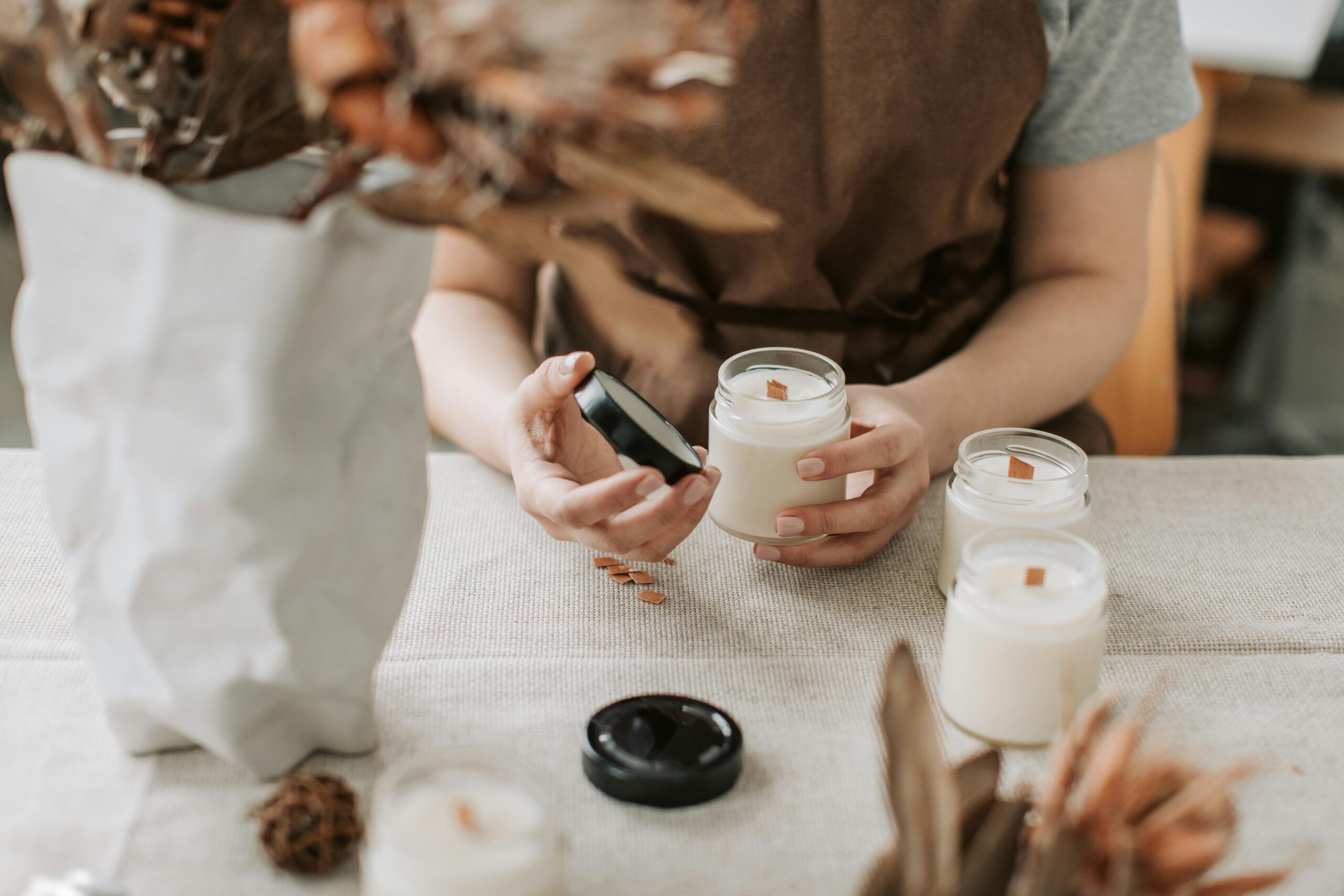
When creating personalized candles for yourself or gifts for others, begin with high-quality supplies. Using good materials will help you end up with candles that look good and last as long as possible. Here are some candle making supplies you’ll need to get started:
Molds, Containers, and Wicks
Choosing the right mold or container is helpful when making different types of candles. Aluminum molds are often used for free-standing candles, while clamshell molds work best for scented wax melts. For candles set in containers, heat-safe glass jars, tins, or ceramic pots provide a reliable option. Selecting the appropriate form helps support the finished candles hold their shape and function as intended.
A wick is needed to keep a candle burning, as it draws liquefied wax up to the flame. Cotton wicks are able to be used in all types of candles and usually come pre-cut with tabs on the end. They can be secured in place with a wick sticker or a small amount of hot glue. Wooden wicks, which create a subtle crackling sound when burning, work only for container candles and are attached with a metal clip to prevent them from burning too low in the container.
Wax and Polymers
Candles may be made from a variety of wax types. Each kind has its own advantages, disadvantages, and limitations. Some common choices for wax are:
- Beeswax: Because beeswax is natural, it burns clean and dripless. You are able to find it in both yellow and white. It has its own natural fragrance and is a renewable resource.
- Soy wax: A plant-based option suitable for containers and scented wax melts. It has a low melting point and can hold a high amount of fragrance. Soy wax is generally too soft to use on its own for tapers or other free-standing candle types.
- Paraffin wax: This wax is petroleum-based; it offers a good scent throw and creates a smooth finish on your candles.
Polymers can be added to paraffin wax to improve its properties and enhance performance. They are able to help a candle’s scent last longer or extend its burn time. While Vybar 103 Polymer works with a wide range of waxes, Vybar 260 Polymer is specifically formulated for paraffin waxes with high melt points. Using the right polymer may help achieve the desired results for different candle types.
Fragrance and Color
Fragrance and color are helpful supplies for candle making because they influence the candle’s overall appearance and experience. Adding high-quality fragrance oils or essential oils is able to help the scent remain noticeable even before the candle is lit. There is a wide variety of fragrances available, including options like vanilla, rose, ocean breeze, and cranberry spice. Some fragrances are also free from phthalates, parabens, and animal testing, providing additional choices for different preferences.
Wax color can be customized using either color blocks or liquid dye. Color blocks are compatible with all types of wax and are designed to be easy to use, as they are scored and are able to be broken in half. By consulting a color chart when selecting blocks, you could determine how vibrant the color will be when added to a specific amount of wax.
Liquid dye allows for more precise color adjustments, as it can be added drop by drop. This makes creating pastel shades or unique color blends simpler than using color blocks. However, measuring and pouring liquid dye requires care to avoid spills during the coloring process.
Digital Scale and Thermometer
A digital scale is recommended for accurately weighing the candle making supplies that will be added to your wax. Color blocks and liquid dyes often provide weight guidelines based on the amount of wax being used. For color blocks, the weight of the wax is able to help determine how many blocks to add, while liquid dye can be measured in drops to gradually reach the desired color. Measuring supplies before adding them supports more consistent and reliable results.
A thermometer is also a needed tool when working with wax. Measuring the wax temperature before adding color or fragrance helps the ingredients bind properly. It is also necessary to check that the wax is not too hot when pouring into clamshell molds, which could cause the molds to deform. Recommended temperatures are usually listed on product instructions. Both standard candy thermometers and digital probes can be used to monitor them.
Gathering Your Candle Making Supplies
Whether you decide to start big or small, you can use this information to determine what you need to add candlemaking to your crafting repertoire. Your candle supply shop is also a great resource for additional information and answering questions. Find key candle making supplies at an online apothecary shop today.